
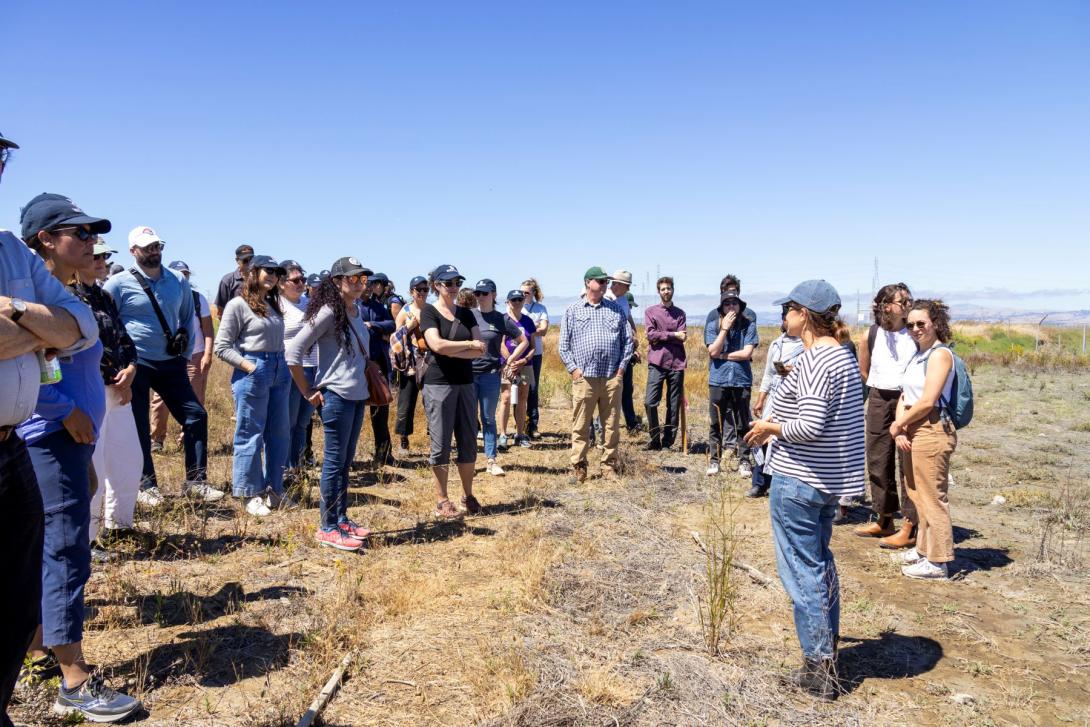
On Tuesday, July 30th, a group of nearly forty people wearing hiking vests, sunglasses and baseball hats gathered on a bright sunny day at the edge of the South Bay for a tour led by the San Francisco Bay Restoration Authority (SFBRA), co-staffed by the San Francisco Estuary Partnership and the State Coastal Conservancy. The goal of the tour was to bring partners and supporters to see the progress of three distinct destinations connected to the South Bay Salt Pond Restoration Project. The tour was both a celebration of collaboration and the continuous dedication needed to implement the largest tidal wetland restoration project on the West Coast.
Why is this work important?
The San Francisco Bay lost over 90% of its wetlands as the region urbanized and converted to salt ponds, farmlands, airports and cities. The South Bay Salt Pond Project, led by the State Coastal Conservancy, is working to bring local wetlands back with the help of a broad collection of partners, organizations and dedicated individuals that include the San Francisco Bay Restoration Authority, U.S. Fish and Wildlife Service, U.S. Army Corps of Engineers, California Department of Fish and Wildlife, Ducks Unlimited, Save the Bay, and the California Natural Resources Agency, among others.
The range of partners is key due to the scale of this 50-year effort to restore 15,000 acres of regional wetlands. The good news is that we are almost halfway there! Restoration at this scale is not only an environmental feat but pivotal to transforming former industrial salt ponds into thriving wetlands that enhance habitat, provide flood protection to areas between Hayward and Menlo Park, and are open to the public for recreation.
What three destinations were featured on this tour?
The tour of the South Bay Salt Pond Restoration Project highlighted the following locations:
Eden Landing Ecological Reserve
The South Bay Salt Pond Restoration Project is the largest tidal wetland restoration project on the West Coast.
“Eden Landing is a special place. Look at where we are standing…We are lucky to be working on it. I’ve spent my entire career working on it,” said John Krause from the California Department of Fish and Wildlife, just before asking participants to take a 360 degree look at the site. On the left-hand side, we saw marshlands restored in 2011 and already well vegetated and also still serving as an important migration stopover for various birds as it transforms into an ecosystem resembling older marshes. On the right side of the trail are the wetlands restored over 20 years ago, lush with native vegetation (including pickleweed and cordgrass), tidally influenced water and hidden underwater life.
Managed by the California Department of Fish and Wildlife, additional aims include restoring these marshlands to pre-industry levels, balancing restoration with the needs of migrating wildlife, continuing to build in flood protection components, and supporting broadening public access features including a kayak launch pad, access to the Bay Trail, parking and interpretive features.
Alviso Environmental Education Center/ South San Francisco Bay Shoreline
The second stop on this tour was the Alviso Environmental Education Center at Don Edwards National Wildlife Refuge managed by the US Fish and Wildlife Service. As we filed out of our respective carpools, we headed towards the community hall for a quick introduction to the space, and then listened to a speaker series where we learned how the South Bay Salt Pond Project is not only critical to recovering the broader marshlands, but in increasing flood protection for the low-lying community of Alviso (a part of San Jose) through the South San Francisco Bay Shoreline Project.
The South Bay Shoreline Project, a sub-project of the South Bay Salt Pond Restoration Project, focuses on providing flood protection for surrounding cities, restoring 2,900 acres of former salt evaporation ponds, and improving public access in the Alviso area of South San Francisco Bay. Speakers from Valley Water, the US Army Corps of Engineers and the Coastal Conservancy provided an update on the Shoreline project, sharing plans for the 4-mile levee and the 3,000 acres of wetlands undergoing restoration. After the informative talk, participants took turns touring the Bird Tower at Alviso Environ which offers a stunning view of the beauty of the marsh and insight into incoming levee construction.
Bedwell Bayfront Park
The last stop on the tour was to view the Ravenswood Ponds from Bedwell Bayfront Park. This project site neighbors many Silicon Valley cities such as Menlo Park, Redwood City, and East Palo Alto. Just last year, this was the site of the intentional levee breach that allowed for 300 acres (about half the area of Central Park in New York City) of tidal marsh to be restored. The breach enabled a marsh connection that hasn’t been made in around 100 years, but will now help protect water quality, restore native habitat, and increase park accessibility for the public.
As the tour wrapped up, we had a moment to soak in the amazing work that has been accomplished during our 20-years plus of collaborative work that spans three counties (Alameda County, Santa Clara and San Mateo). There is a lot to be proud of and a lot more work ahead of us as we move consistently and purposely onwards.
Stay abreast of project developments, by visiting either the South Bay Salt Pond Project or the South San Francisco Bay Shoreline Project websites.
Association of Bay Area Governments staff, working as the San Francisco Estuary Partnership, collaborate with various regional partners on the South Bay Salt Pond Restoration Project, and many other important environmental initiatives. For over 30 years, the San Francisco Estuary Partnership has worked together with local communities and federal and state agencies to improve the health of California’s most urbanized estuary.
See all of the ABAG’s Top Stories.