
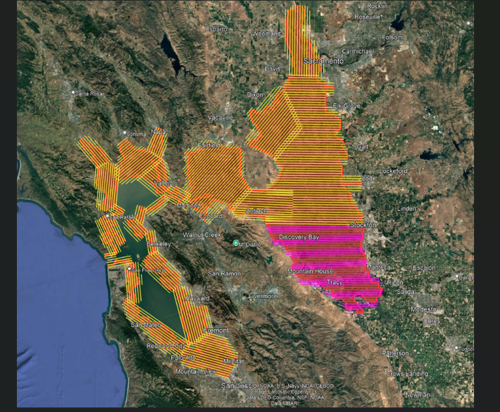
LiDAR flight plan and progress map for the San Francisco Baylands and San Joaquin Delta. Areas in pink represent completed flight lines as of Aug. 21, while yellow lines indicate planned coverage.
The San Francisco Estuary Partnership is co-managing the first laser survey of San Francisco Bay and the Delta to enhance understanding of wetlands, shorelines and restoration progress.
This summer marked a major milestone in regional data collection as the Wetland Regional Monitoring Program — co-managed by San Francisco Estuary Partnership and San Francisco Estuary Institute (SFEI) — undertook the first comprehensive LiDAR (Light Detection and Ranging) survey of San Francisco Bay and Delta. The work is in partnership with the San Francisco Bay Restoration Authority and several key agencies.
LiDAR is a remote sensing technology that uses lasers from aircraft to produce precise, 3D maps of the Earth’s surface. The effort gathers high-resolution elevation data during low tide, creating the first LiDAR dataset to span the entire estuary.
LiDAR tracks changes in wetland elevation and vegetation over time. This new dataset supports several WRMP goals, including updating the Baylands Habitat Map 2025, which the WRMP uses to monitor changes in wetland extent, habitat types, vegetation and other wetland characteristics.
The work will also establish a baseline for future wetland restoration and shoreline resilience planning. Read more.
See all of the ABAG’s Top Stories.